Thursday, 25 September 2014

Things that are made from a pig


So guys, I know topic can be a bit sensitive but I was watching my fave tv show ever QI and they were chatting about what things in everyday life are made from pigs and i found it horrific and wants to educate people on what they are using. 


 It is not only sweets that contain pork gelatine. In some beers, wines and fruit juices, pig gelatine is used to remove the cloudiness from the drink. It works as a clarifying agent by reacting with the tannins in the liquid and absorbing the cloudiness. 

Some ice creams, whipped creams, yoghurts and certain butters also contain gelatine, as do certain pet foods. More surprisingly, a number of medicines also contain pig gelatine  -  everything from painkillers to multivitamins. 

Hygiene and beauty products are also made of pig. Fatty acids extracted from the bone fat of pigs are used in shampoos and conditioners to give them their shiny, pearl-like appearance. These acids can also be found in a number of body lotions, foundations and anti-wrinkle creams. Glycerine made from pork fat is also an ingredient in many types of toothpaste. 

Christein, from Holland, found that while some companies were reluctant to cooperate in her quest, others claimed that they didn't even realise their products contained elements taken from a pig because of the middle men involved in the complex distribution process. 
The confusion is not helped by the fact that it is not clear on products' ingredient labels where they originally came from. 
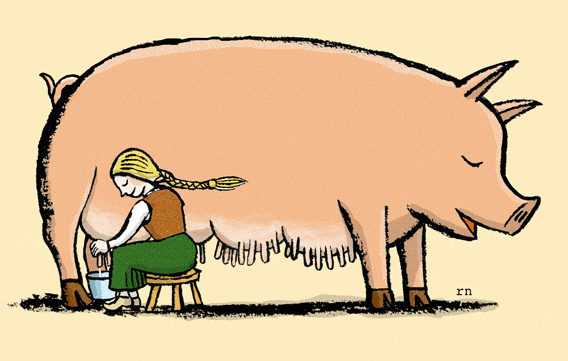
According to the Food Standards Authority, there is no legal obligation for manufacturers to specify whether the gelatine they use is from a pig or another animal. When it is specified, it is often confusingly referred to as Suilline gelatine. 

According to Richard Lutwyche  -  a British pig farmer with more than 60 years experience, chair of the Traditional Breeds Meat Marketing Company and a member of the British Pig Association  -  the reasons for much of this confusion is due to the industrial-scale of much pig farming. 
'In the UK, big commercial farms send their pigs to large abattoirs. The abattoir will find different markets for all the by-products,' he says. 'Everything they can't sell they have to incinerate, so it's in their best interest to sell as much as they can. 

'There's an old expression that says: when it comes to pig, you can use everything but the squeal. Over the past 100 years those uses have expanded rapidly.' 

Some of the surprising products that can include pig material include photographic film, which uses collagen from pig bones; shoes that use bone glue from pigs to improve the quality of the leather; and certain paints that use bone fat to enhance their glossy properties. 

Some makers of cigarettes use haemoglobin from pig's blood in their filters. Apparently this element works as a sort of 'artificial lung' in the cigarette so, they claim, 'harmful reactions take place before the chemicals reach the user'. 
And the next time you buy a loaf of bread you would be well advised to read the packaging. Some manufacturers use an ingredient called L-cysteine, which is a protein made from pig or other animal hair and which is used to soften the dough. 

A product like Tesco's Plain Tortilla Wraps includes this ingredient. The strangest use for a pig by-product that Christein found was in bullets and explosives. Pig bone gelatine was used to help transport the gunpowder or cordite into the bullet. It is difficult not to be impressed by the sheer versatility of this animal and its parts. 
Virtually nothing in a pig goes to waste. 


Wednesday, 3 September 2014

Why test on animals?

Many items purchased and used by us everyday, cleansers, cosmetics, drugs, are nearly always subjected to government regulations requiring that they be “safe” for us humans to use in everyday life. Businesses  are responsible for using toxicity animal tests on these types of products, including their active ingredients, before they enter the shops. The test results are then submitted to regulatory agencies that determine whether the data are sufficient for labeling and marketing the product. The toxicity testing for many types of products still involves testing on animals. 


Why the Bunnies? 


Products have to be safe for us humans to use either to put inside use aka tablets etc. Or put on our skin or clean our house with. They are tested so it can be safe and meet requirements to find out if it will harm us or be fatal to anyone who uses it. Even cosmetics with is not regulated commonly test on animals for safety. Many of these tests are toxicity tests done on either mice,rats or bunnies. Some of these tests required by FDA or EPA also use dogs,primates and other animals.  A toxicity test is required to find out the potential risks of each chemical. Tests will differ depending on the product type.

The most common test is the Draize rabbit eye test, intended to predict whether that product will cause injury to the human eye. The test involes placing an amount of product into the eyes of the rabbit up to 6 rabbits at a time and keeping a record over a course of 21 days. The nature of this is nothing but cruel with the animal in a lot of pain. This test has been proved to have poor results and not always the same result that a human would have.


Progress for non-animal testing is on going, but is very slow, disorganized and subject to backlash.

The Draize test for skin irritancy, which was first introduced in 1944, has been used to measure the response produced when a test is applied to the shaved skin of a group of animals, and can cause intense pain, burning and itching. (Skin is abraded by firmly pressing adhesive tape onto the animal’s body and quickly stripping it off.  The process is repeated until several layers of skin have been removed.)


Another traditional animal  test is called the  LD50 test, which stands for the lethal dose of a given test substance in 50% of the test’s animal population. The test, is done on mainly on mice and rats, is commonly used to for the human health of acute oral systemic toxicity where animal subjects are force-fed oral doses of the chemical being tested. This oral systemic test is used as a general indicator of the overall relative toxicity of a substance. Many scientists claim that the oral LD50 test has little relevance to evaluating the human safety of a substance, and some places  and international organizations have withdrawn their requirement for this type of test data. Progress toward replacing the LD50 test with alternative non-animal methods has been ongoing, but the test involves toxicity to the whole organism, and is therefore biologically complex.


Subchronic toxicity tests are used to determine toxicity from repeated exposure to a chemical over a period of several weeks to several months.  These tests usually last less than 10% of the test subjects’ natural life span.  Subchronic toxicity tests are used to measure the toxicity in chemicals, food additives, and even common spices such as paprika.  Hydroquinone, a chemical commonly used in skin lightening, age spot, and blemish creams, was also tested using these tests.

Chronic toxicity tests assess risks of long-term exposure - often at low levels for a substantial portion of the test subjects’ life - such as the potential to cause cancer, birth defects, and developmental abnormalities. They may also explore the body's absorption, distribution, metabolism, storage, and excretion of new chemicals and products, and/or monitor the long-term effect of a chemical on the brain, DNA, and nervous system. Lifetime animal-feeding studies, such as those conducted over the two-year lifetime of a rat or the 18-month lifetime of a mouse, are examples of chronic-toxicity tests.

Ref : www.mspca.org

Alternatives Development

In response to worldwide interest in reducing animal use in product safety testing, a growing number of alternative tests have been developed that replace, reduce, or refine animal tests .
In vitro tests (involving cell and tissue cultures grown "in glass" in the laboratory) are among the alternatives showing the most promise in product testing. They are faster, cheaper, and often more reliable than animal tests. Some completely replace animals while others reduce their numbers.  Additionally, tests that are in silico (computer-based) have also reduced the numbers of animals used.  While these methods often eliminate the need for animals in the early stages of research, animals are often needed in later stages of product development.  Still other alternatives, called refinements, make tests less painful or stressful for the animals involved.

Tuesday, 2 September 2014

Animal testing on Big Brands


So recently I have done some research in to the products that I have been using either on my face or body.

I noticed that nearly all if not all of the products were tested on animals. Which really shocked me, I never realized the lengths companies went to with there products, this article is not to scare you or make you change your mind, its just so you can have some knowledge of what id out there and what your product was doing before your put it on your face,hair or body. 

This is just going to be a list and tiny example of what these companies do :) Dont be scared, just have a nose! 

Which companies and brands still allow testing on animals?


1.Andrew Collinge

  1. Andrew Collinge
  2. Anna Sui 
  3. Aramis
  4. Aveeno
  5. Band-Aid
  6. Bobbi Brown
  7. Bonjela
  8. Braun
  9. Caharel
  10. Cashmere Bouquet
  11. Chapstick
  12. Clairol
  13. Clean and Clear
  14. Clearasil
  15. Clinicare
  16. Clinique
  17. Colgate
  18. Crest
  19. Decore
  20. Disprin
  21. Dolce and Gabbana
  22. Donna Karan
  23. Dove
  24. Durex
  25. Elizabeth Arden
  26. Eulactol
  27. Garnier
  28. Gillette
  29. Gucci 
  30. Head and Shoulders
  31. Hugo Boss
  32. Herbel Essences
  33. Impulse
  34. Johnson and Johnson
  35. Kerastase
  36. Kiehls
  37. Lacoste
  38. Lancome
  39. Lemsip
  40. Listerine
  41. Lux
  42. Lynx
  43. MAC
  44. Max Factor
  45. Maybelline
  46. Michael Kors
  47. Missoni
  48. Mum
  49. Nair
  50. Neutrogena
  51. Nice N Easy
  52. Nurofen
  53. Olay
  54. Old Spice
  55. Optex
  56. Oral B
  57. Palmolive
  58. Pantene
  59. Pearl Drops
  60. Pears
  61. Pert
  62. Plax
  63. Ponds
  64. PPS
  65. Radox
  66. Ralph Lauren
  67. Reacg
  68. Redkeen
  69. Rexona
  70. Revlon
  71. Rogaine
  72. Sanex
  73. Savlon
  74. Scholl
  75. Sensodyne
  76. Simple
  77. St Ives
  78. Strepsils
  79. Tampax
  80. Tom Ford
  81. Tony and Guy
  82. Tommy Hilfiger
  83. TREsemme
  84. Vaseline
  85. Veet
  86. Venus
  87. Vicks
  88. V05
  89. Viktor and Rolf
  90. Waxeeze
  91. Wella
  92. Zest
beauty brands that do not test on animals


This blog is hear to just make you aware, please keep an eye out for a blog tomorrow more about animal testing and more on skin care,hair and household in the coming weeks 


Wednesday, 23 April 2014

Catrice Camouflage Concealer


MY OPINION


I am always on the hunt of good heavy coverage concealers to deal with my extremely bad dark circles. After wasting money on  Benefit Boi-ing(€22.00) I decided to stick with cheaper options and try one from Catric they are suppose t have good/great concealers


I have tired the Catrice All-In-One Concealer Palette  which is a great palette to have in your collection. I decided to chose the Catrice Camouflage Concealer. I bought one shade the lightest one, as I am very pale , to create a perfect match for my under eyes. If you have very bad dark circles, one of the good tips I have learned on the way is to use a concealer that matches your skin tone or is slightly darker. That way you won't be left with a grayish cast.


This concealer is just amazing,  Really! It lasts all day, covers all my dark circles and looks great and natural.  If any conealer actually hides and removes all traces of my dark circles, this is it. . This concealer is very creamy and thick enough to give pretty amazing coverage. It blends so nicely too. The only downfall is that it creases. It creases all throughout the day if not set properly. What I do is that after setting it with a pressed powder I always apply a neutral eyeshadow over it if I am not doing any eye makeup that day. That way it lasts a long time without creasing. 

This concealer is dirt-cheap and better than any high-end. I definitely, definitely recommend it to people who want high-coverage especially for under eye area.


CATRICE CLAIMS
A true must-have for a flawless complexion. The Camouflage Cream with a long-lasting texture blends perfectly with the skin for invisible correction. It reliably covers irregularities of the skin, pigmentation stains and red veins. The efficient Camouflage Cream offers a high coverage and can be kept in place with powder for a waterproof effect.


PRICE & AVAILABILITY
€4.50 - Boots

Tuesday, 22 April 2014

Clearasil Daily Clear Skin Perfecting Wash


Clearasil Daily Clear Skin Perfecting Wash is a great facial wash. It comes in a convenient pump action bottle. It is excellent to sit on the bathroom sink, ready to go. I decided to give the wash a try for a week to see what it was like.
I like to cleanse and exfoliate as part of my morning routine. I thoroughly wet my face and neck then add a small amount of the creamy cleanser, massaging in circular motions creating a rich lather. I can feel the tiny micro beads with the lathering massage. I like to massage for a couple of minutes on my face and neck to ensure my face is thoroughly cleansed and it also gives the micro beads a chance to exfoliate dead skin cells.
I then thoroughly rinse making sure all the wash is gone.
My skin feels taut, well cleansed, and smooth. My pores actually feel like they have had a good scrub, all the pore clogging oils and grime gone.
I make sure I moisturise after cleansing so my skin is soft and nourished.
I think the wash is worth a try if you suffer from breakouts and blackheads or you just want a thorough face cleanse.
Clearasil Daily Clear Skin Perfecting Wash can be purchased from Supermarkets and is Made in France.


*Designed for sensitive skin, this daily facial cleanser cleanses and gently exfoliates. Enriched with a facial moisturiser complex, it gives clearer skin every day


Price - €5.50
Stores - Boots, Tesco, Bigger Pharmacies


Thursday, 17 April 2014

Rimmel - Scandal Eyes Show Off Mascara


I got his mascara the other day, I just picked it up by chance and said I will try this, this mascara has a strange looking brush with a round bristly end. According to Rimmel, the flat brush volumes the lashes and the round brush at the end lifts and defines. When put to the test, this mascara was kinda hard to apply at first, I didn't really like the formula, I tend to like really wet mascaras and this was just not wet at all. But after a few tries of this, I worked out how to get the best of this product and that is the layer it on. I put on one coat wait about 30 secs then put on the next coat, this works so well and I can really see the benefits when I do this. 


My lashes have never looked so long, fluttery and volumised without looking like  fake eyelashes, which I love because I hate the process of applying fake eyeslashes, there just very messy and I hate the feel of them, So when this happened I was so happy because It is what I was exactly looking for.
I’m happy to say that I have found my new favorite mascara. Rimmel Scandal Eyes Show Off Mascara has officially become my Go to mascara! The only downfall is that its not waterproof and in Ireland you need waterproof with all the rain and wind we get here.

What do you think of the Rimmel Scandal Eyes Show Off Mascara? 
  • Product: Rimmel Scandal Eyes Show Off Mascara
  • Availability: Boots / Bigger Pharmacies 
  • Price: €8.65

Tuesday, 21 January 2014

Clean and Clear - Spot Treatment Gel


Clean and Clear Review 


Let me just say that apparently I’m 24 going on 13. I don’t know what happened but I’ve suddenly broken out like a pubescent teenager. Hormones, stress, not sure what. Either which way, we all get pimples now and then and for whatever reason I’ve suddenly got months worth at once.  During a recent food  shop in Tesco I stopped in the skin care aisle to look for some creams or spot treatment or a magic wand to help my face be normal looking again. I browsed through the aisle and stopped at the Clean & Clear products as I remember liking some of their when I was younger. I came across a few very similar products and to be honest with you I don’t know the exact difference between them, but I picked up Clean & Clear Advantage Acne Spot Treatment its about 5.50euro


The packaging  says that 100% of users saw a difference within 4 hours of application. That’s a pretty hugh claim and I was anxious to see how it would help my problem area. The directions said to cleanse skin and apply 3 times daily. I haven’t been wearing any makeup to allow my skin time to heal so as soon as I got home I applied it. It is clear, has a chemical scent and the consistency is a thin gel. Upon using it felt cool on my skin and tingled/stung a little bit – which I was glad about. 

I came back for a peek a few hours later and I was shocked. The puffiness of each blemish had decreased as had the redness surrounding it. I knew they claimed I would see results almost immediately but I didn’t think I actually would. As this product does create a thin film on the face I washed it off and applied more to fresh skin. After applying it 4 times (I know they said 3 but you can’t stop me now!) I was amazed and am thrilled to say that I saw a remarkable difference in just one day. 


 Clean & Clear Advantage Acne Spot Treatment


I am so happy to have found this product. I do not often have break outs as grand as this but believe this product will be useful in combating even the random pimple that appears.